Schedule Assistant: Book, access, and share recordings
This guide outlines the process for creating, accessing, and sharing ad hoc recordings such as public seminars, departmental meetings, conferences and guest presentations in capture-enabled venues.
Staff at the University of Melbourne can schedule a recording for any event held in a supported venue using the Schedule Assistant. Once completed, the recording will be located in the staff member's EchoVideo Library.
Note: Recordings for centrally timetabled lectures do not need to be booked; any alterations to the timetable will automatically adjust the recording schedule. If you are encountering mismatches between a subject’s timetable and its scheduled lecture captures, please submit a support request.
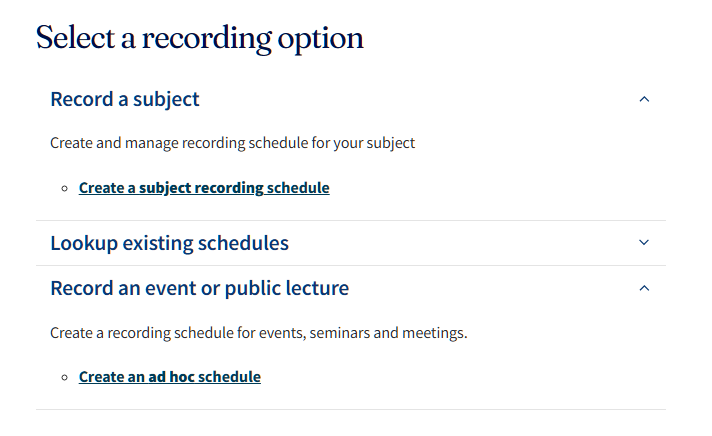
When viewing the tool, you will find two main recording options:
- Record a subject allows you to schedule recordings for subjects for which you are listed as an instructor. Once the recording has been completed, it will be automatically published to that subject.
- Record an event or public lecture allows you to schedule an ad hoc recording. Once completed, the recording will be located in your EchoVideo Library where it can then be edited or shared as needed.
Record an event or public lecture
- Log in to the Schedule Assistant.
- Click on Record an event or public lecture and select Create an ad hoc schedule.
- From there, enter the following the details:
- Recording title.
- Room to record. Refer to the room search website for more information on capture-enabled venues.
- Type of recording.
- Recording date.
- Start time. Note that due to system limitations recordings will begin 2 minutes after the selected start time.
- Duration.
- Click Add to schedule.
- You will be presented with a confirmation of the schedule once completed. You can check your booked recordings through the My Recordings section of the self service tool. To create another recording select Add another adhoc schedule.
If you encounter an error message, it is likely because the time/date requested for the recording is conflicting with an existing schedule. Please submit a support request if:
- You are encountering an error message and there is no conflicting schedule.
- You need to adjust or delete a scheduled recording request.
Note: Centrally timetabled lectures created through TimeEdit take precedence over ad hoc recordings. In the event that a timetabled lecture is required in place of your scheduled ad hoc recording, you will be notified that your recording will need to be removed and rescheduled.
Access and manage your recordings
Once your recording has been processed it will be available in your EchoVideo Library. To locate it:
- Log into EchoVideo using your University credentials (for example, jmedley@unimelb.edu.au)
- Once logged in, you will be directed to your Library by default. In this tab, scroll down to the Media section to locate your recording. Note that once a recording has been completed, it will take time to process and from there for auto-transcription to be generated.
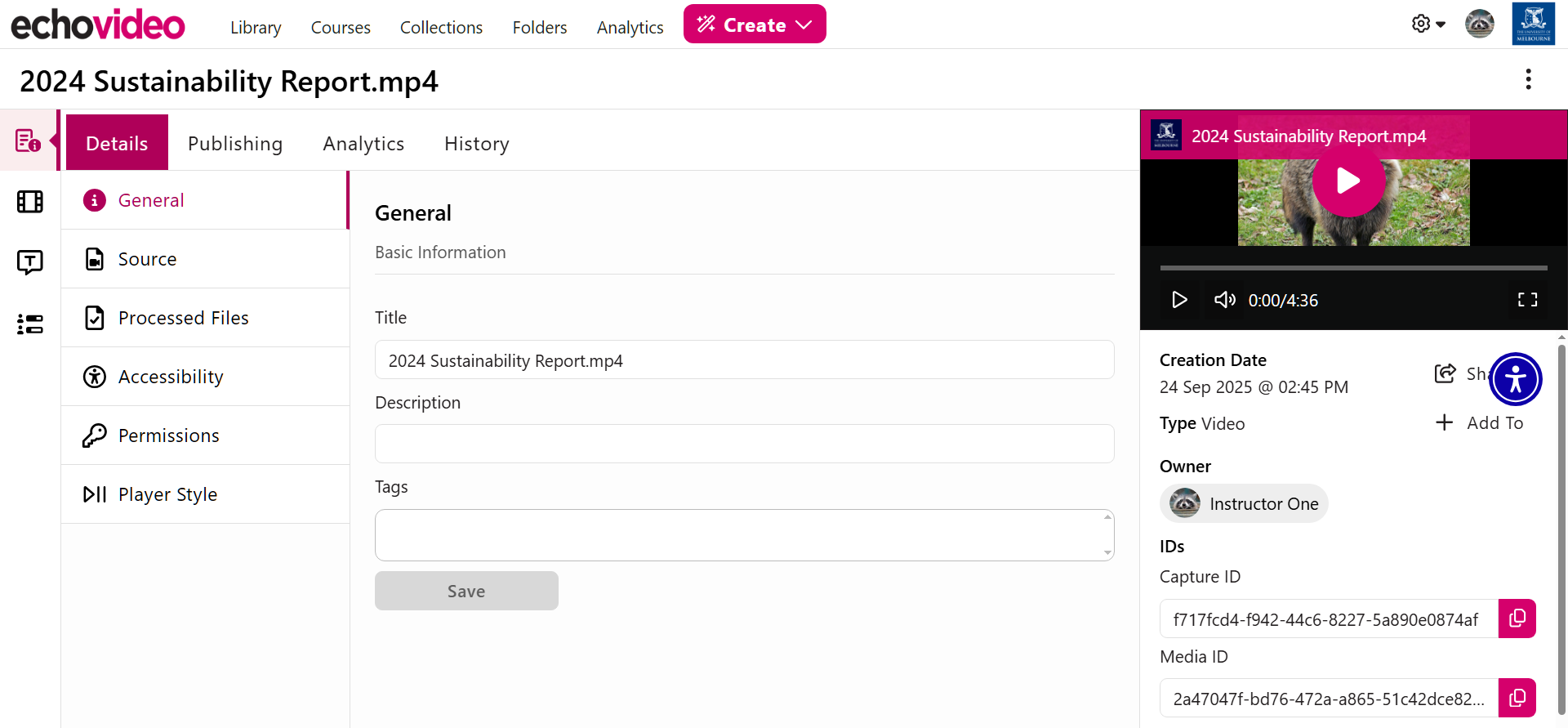
- Once processed, click on the recording to access its media details page where you can edit and share the recording.
Edit media
Located on the left-hand side of the media details page, there are two main editors.

Media Editor which provides basic video editing functionality where cuts and trims can be applied. This allows for post-production tasks on recordings, such as the removal of inessential or sensitive information. More information can be found in the vendor guide on using the media editor.

Share media
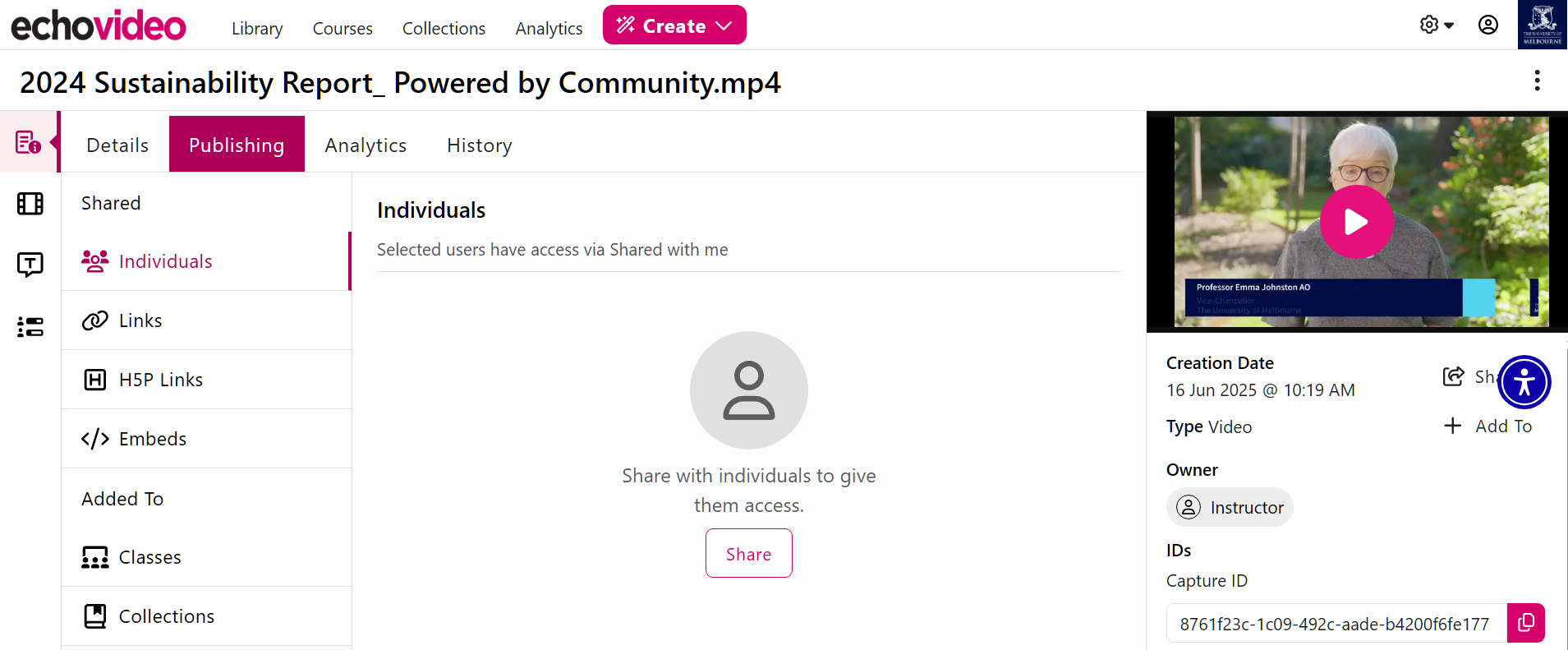
Under the Publishing tab, you can find options to share the media via:
- Individuals: Share the link directly to other EchoVideo users
- Links: Create a link which you can share to other users
- H5P Links: Create a link that you can use in an H5P activity
- Embeds: Create an embed code that you can use to embed the media (For example, in an LMS page)
Alternatively, you can add the media to:
- Classes: This provides access to the media for all users enrolled in a Class.
- Collections: This provides access to the media for all members in a Collection.
Support and resources
Submit an LMS support request for further assistance or to report any errors or omissions in this guide.
This guide was last updated 27 Nov 2025.
Submit an LMS support request for further assistance or to report any errors or omissions in this guide.