EchoVideo: Managing recordings
How to use some of the extended functionality of Lecture Capture (EchoVideo), including managing, editing and copying recordings.
Trim or cut recordings
The Media Editor in Lecture Capture provides basic video editing functionality where cuts and trims can be applied to video content from either the LMS or EchoVideo. This interface allows for post-production tasks on recordings, such as the removal of inessential or sensitive information.
To access the Media Editor via the LMS:
- Go to the subject where the media belongs.
- Select Lecture Capture in the left-hand subject navigation menu.
- Next to the target media, click on the Media icon and select Edit Video.
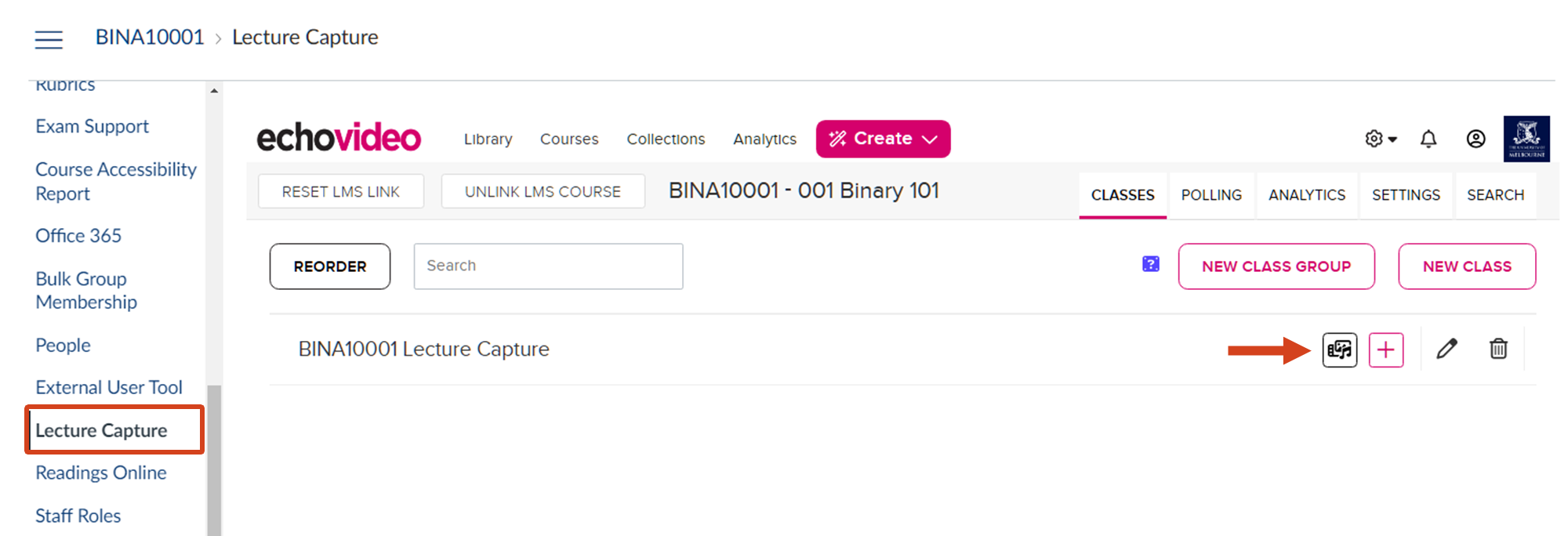
To access the Media Editor through EchoVideo:
- Log into EchoVideo, and navigate to the Library or Courses tab (depending on where the video is located).
- If the media is in your Library: Select the video and click on the Media Editor icon on the left-hand side of the screen.
- If the media is located in a course: Select the course, locate the video, click on the Media icon and select Edit Video.
Details on how to edit a video can be found in the EchoVideo editing video guide.
Add closed captions
If you have generated your own closed caption files, you can manually upload these to a recording in the Lecture Capture system. Only .VTT file types are accepted as valid caption uploads.
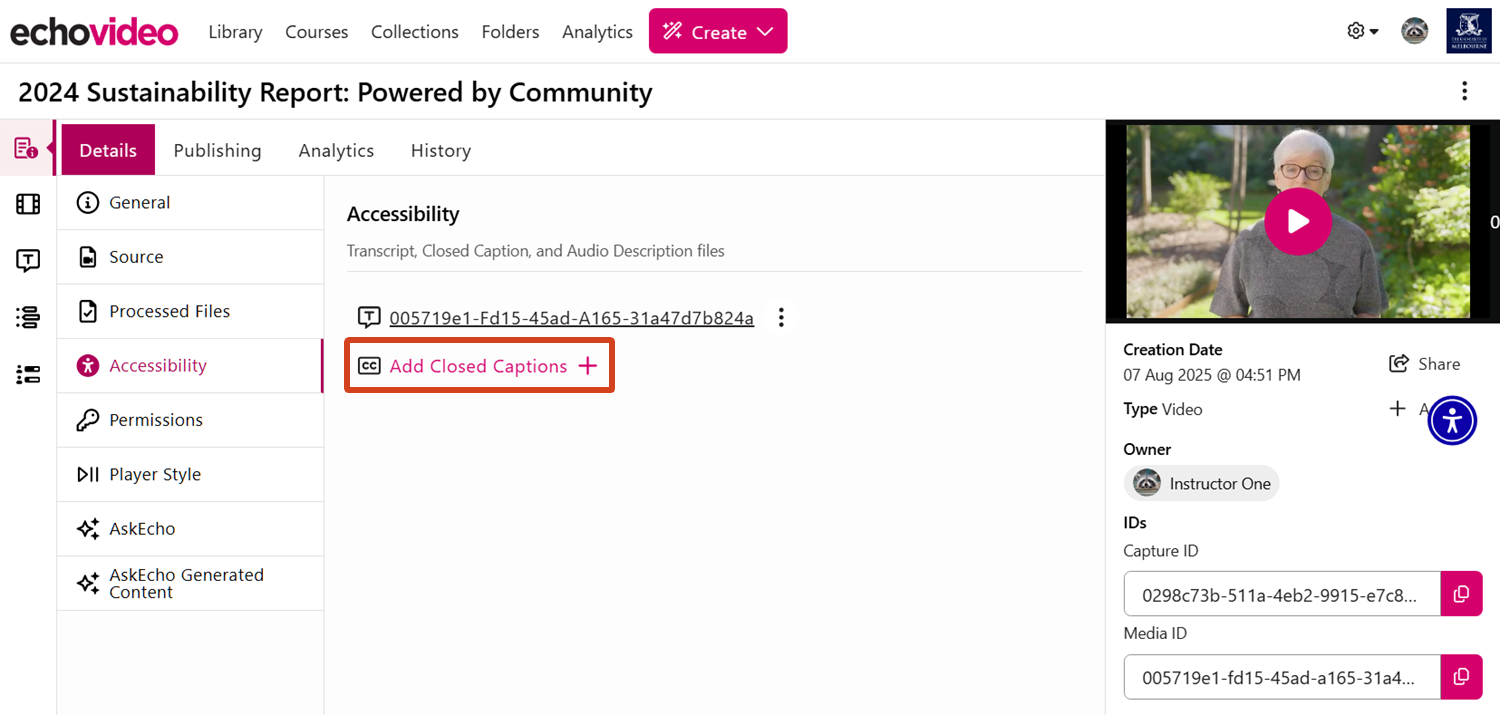
- From the Courses page, click on the Media icon then select Details from the drop-down. Alternatively, find the recording that you have uploaded in the Library page, then click on the file to open it.
- On the left-hand menu, click on the Accessibility tab and select Add Closed Captions.
- Click Upload before dragging and dropping the file from your system into the upload pane, or use the browsing option to select the file, then click Open.
- Once the file is uploaded, it is applied to and synced with the recording video. Please allow time for processing to occur.
Important to note:
- If a user edits the video, the captioning file may need to be re-created and re-uploaded to the edited video.
- Timestamped Closed Caption files must account for the 14-second copyright information attached to the beginning of lecture recordings. If captions for a video need to be edited, we recommend editing captions within Echo.
Instructions on how to edit captions can be found in the automatic transcription services guide.
Add chapters
Once transcription has been created for your media, you can configure chapters using the Chapters tab on the ieft-hand navigation menu.
From this tab, chaptering can be:
- Auto-generated from the media transcript
- Manually added
- Imported using a JSON file.
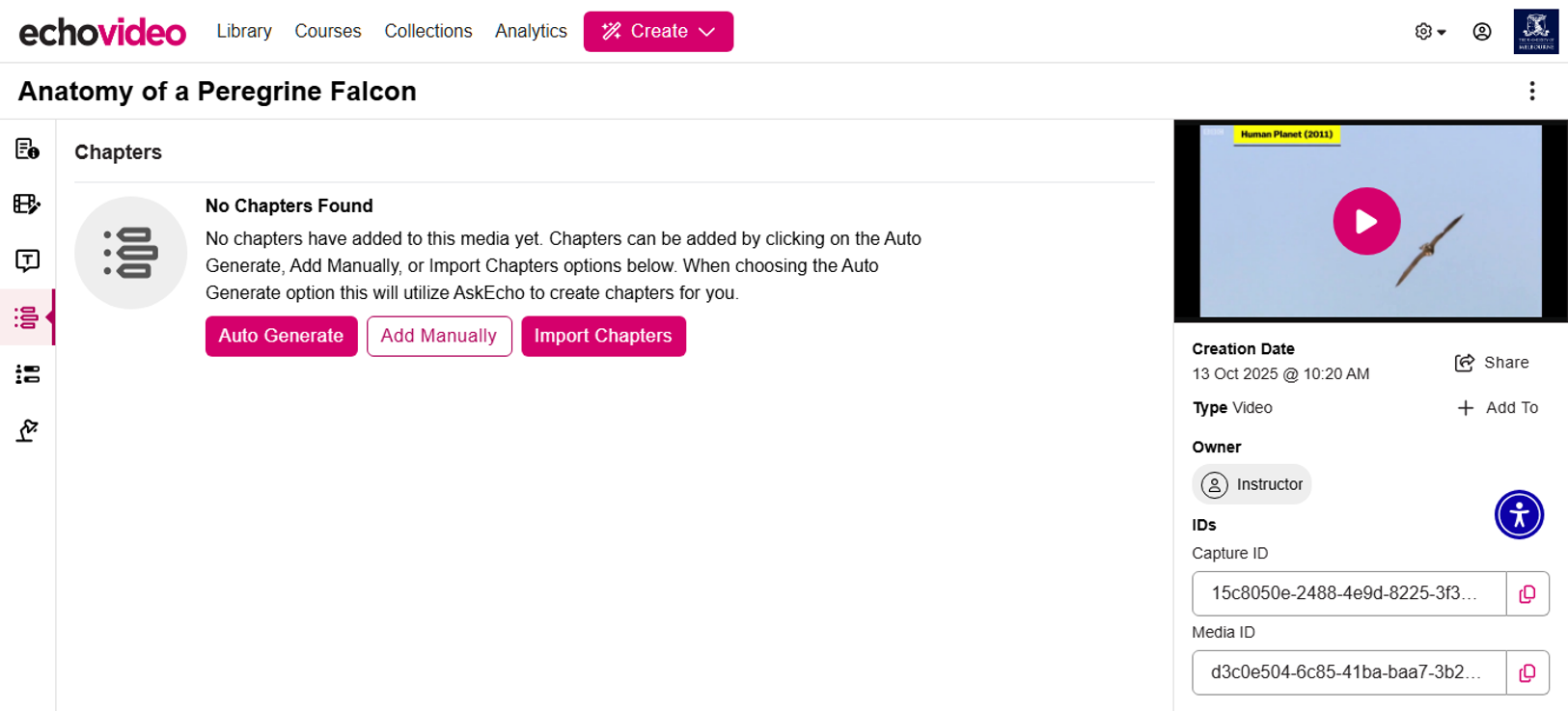
Once created, chapters can be re-generated, manually edited, and downloaded as a JSON file. Created chapters will then appear in the media player via a segmented progress bar as well as in the player’s chapters menu, allowing users to skip to selected chapters when viewing the media.
For more information, visit the vendor guide on generating chapters.
Upload videos from other sources (for example, Zoom)
Video content recorded outside of the Lecture Capture system can be uploaded directly to a course or added to your library. For example, you might want to upload recordings of tutorial sessions that you have conducted in Zoom. Additional content can be added either before a class or after a class has taken place.
Note that only one video file and one presentation file can be added per class, so you will need to make a new class if you wish to upload a second video file (such as a tutorial) as part of a particular week’s learning materials.
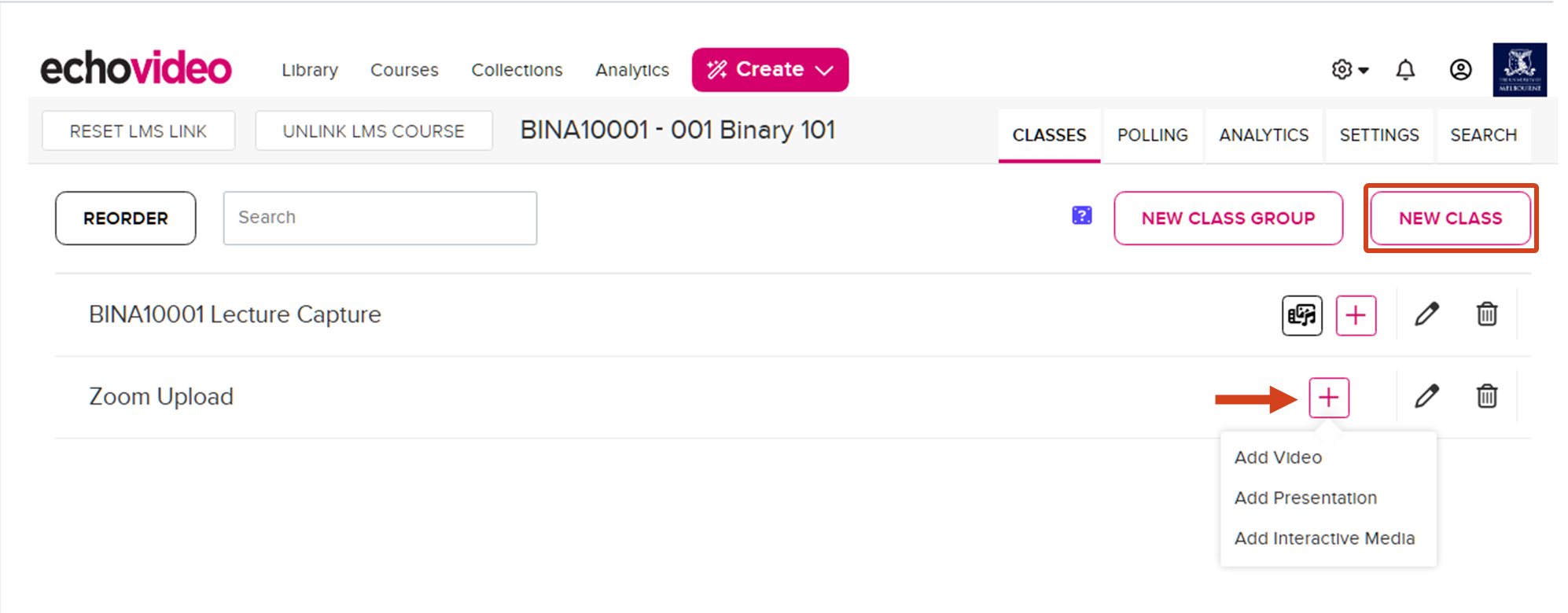
To create a new class and upload your video while in Canvas:
- Navigate to the Lecture Capture page in Canvas and select New Class. Enter a Name - and optionally a Start Date and Description - before confirming with OK.
- Find the new class in the Lecture Capture page and click the Add icon and choose Add Video.
- Select Upload a file and find the video file required using the options provided. Once selected, click Upload.
- Once uploaded, file will undergo processing. Once Processed, you will be able to view or modify the file like with other Lecture Capture recordings.
Any content that is uploaded to a class automatically appears in your Library under My Content. Follow the steps below to publish a recording from your library.
Please ensure any video content uploaded adheres to copyright requirements. For more information, see the Copyright Office website.
Further details on how to upload content to your Library can be found in the EchoVideo uploading media guide.
Creating a playlist
You can now create playlists for audio and video content in EchoVideo to organise subject material into a structured sequence through EchoVideo’s Launch Media Picker.
To access the Launch Media Picker via the LMS:
- Navigate to the item type (for example, Page, Assignment, etc.) within the course you want to create the playlist in.
- Click the EchoVideo button in the content window toolbar.
- Click Launch Media Picker to open a window with your EchoVideo content.
- Select the media (up to 50 files) you want to embed.
Details on how to create a playlist can be found in the EchoVideo playlist guide.
Republish content from a previous semester
Republishing material from a previous semester can be useful in the case a lecture was missed or a hardware issue prevented the recording of a lecture. All courses that you have access to, including semesters that have already concluded, will appear in the Courses tab of your Home page.
To make content from a previous semester available in the current subject:
- Step 1: Copy the required recording to your library
- Step 2: Publish the recording from your library to the current subject
Tip: If a large number of recordings from a previous semester are required, please submit a support request to the Lecture Capture team to publish recordings in bulk from a previous semester into the current semester Lecture Capture page.
Copy recordings
Copying recordings can be an effective way to reuse or repurpose your material from previous semesters or other courses.
To copy a recording to your library:
- Navigate to the Course containing the content that you wish to copy.
- Click on the Media icon to access options for the content.
- Select Create Copy, then OK
The recording will now be available for viewing, editing, sharing and publishing in your library.
Publish a recording from your library
Recordings saved in your library can be published to any course you have access to in Lecture Capture.
- While in the Lecture Capture system, navigate to the Library.
- Locate the required media.
- Hover your mouse over the thumbnail to reveal the drop-down menu and select the Share option.
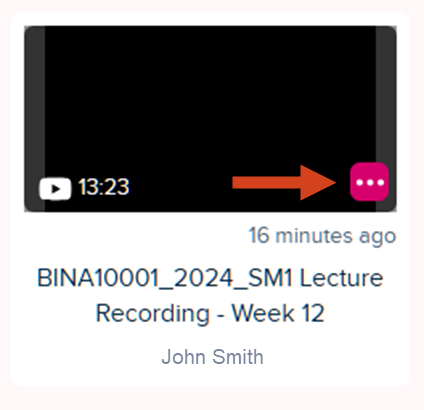
- Select the Share option for the content in your Library.
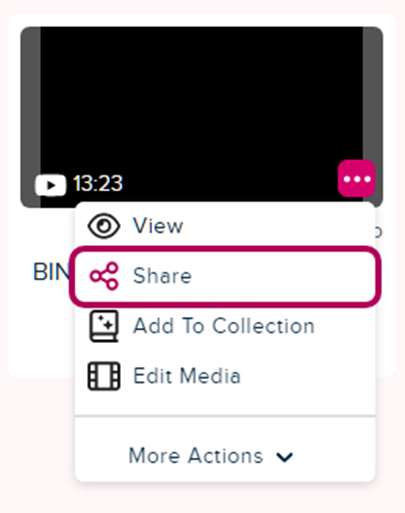
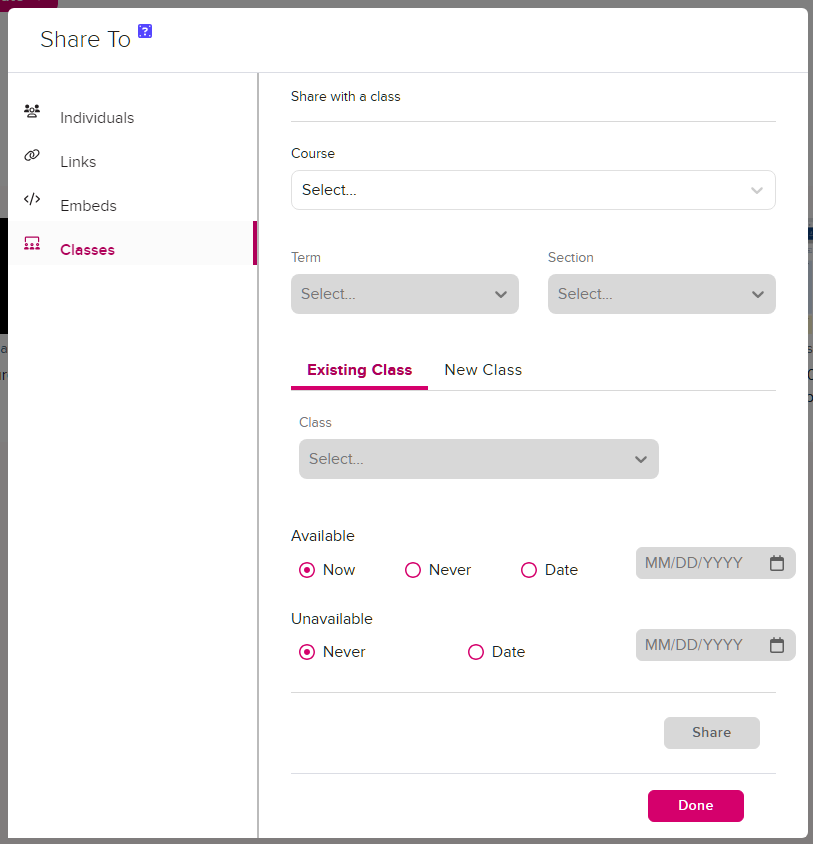
- In the Share Settings pop-up window, select the Classes tab.
- Select the course, term and section (subject) where you wish to publish the recording
- Choose whether you wish to publish the recording to an Existing Class or a New Class.
If publishing to an Existing Class, choose the desired class from the drop down menu. - If publishing to a New Class, use the provided fields to set the Class Name, Date, Time and Duration. Note that Classes must have either a Name or a Day/Date/Duration, although most have both. Class Description is optional.
- Choose whether you wish to publish the recording to an Existing Class or a New Class.
- If necessary, change the Available and Unavailable settings. Note that recordings will become available/unavailable at midnight on the specified date.
- Click Share. The selected recording will now be published to the subject you have chosen.
Make a recording unavailable
The Lecture Capture system allows for staff to control availability of content to students.
- While in the Lecture Capture system, navigate to Classes.
- Click the Media icon and then under the listed options select Make Unavailable, then OK.
The selected content will no longer appear to students and the Media icon will appear grey. Media can be made available again by using the Media icon and selecting Make Available.
The recording will still appear to students in the class list, however the content itself will not be accessible to students.
Set availability of recording based on date
- While in the Lecture Capture system, navigate to Classes.
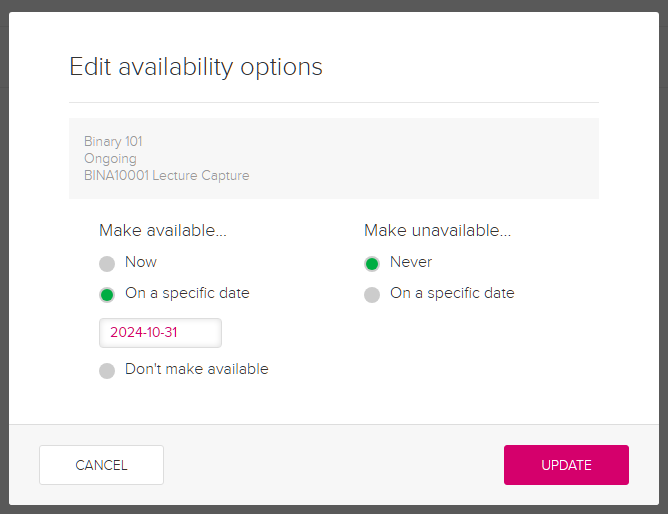
- Click the Media icon and then select Availability Settings.
- Select On a specific date and enter the dates for which the content is to be made available and unavailable, then click Update.
This guide was last updated 19 Aug 2026.
Submit an LMS support request for further assistance or to report any errors or omissions in this guide.